schultetable

Printable task reference

Schulte Table Grid Size and Result Guide

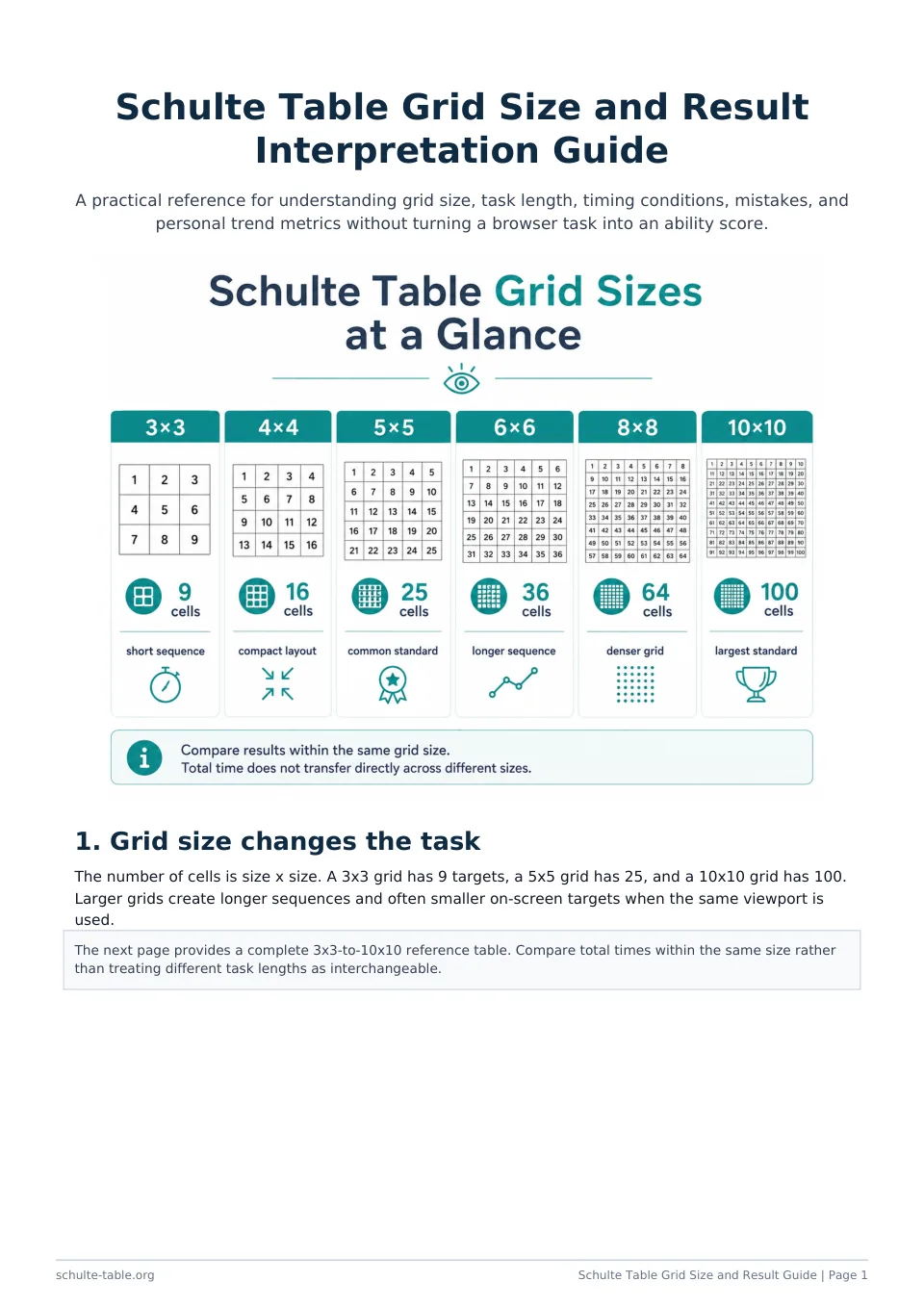
Grid size changes the number of targets and often changes their displayed size. This guide keeps those task facts separate from result interpretation, then shows which conditions should remain stable before two personal attempts are treated as comparable.

Preview of the Schulte Table grid size and result PDF reference
English PDF7 pages

Printable grid-size and result reference

Use the guide when you need a paper reference for task length and comparison conditions. It explains observed task results without introducing universal norms or ability bands.

  • Cell counts for every size from 3×3 through 10×10
  • Device, input, display, time, and mistake context
  • Personal best, median, recent average, and like-for-like comparison notes

How to use this resource

From grid size to cell count

The cell count is the side length squared. A 3×3 has 9 targets, a 5×5 has 25, and a 10×10 has 100. A larger total time on a larger grid does not by itself show slower per-target performance.

  • 3×3 = 9; 4×4 = 16; 5×5 = 25; 6×6 = 36
  • 7×7 = 49; 8×8 = 64; 9×9 = 81; 10×10 = 100
  • Keep totals grouped by grid size before reviewing a trend

Conditions that change a result

Mouse, touch, and keyboard create different input paths. Screen width, orientation, zoom, target spacing, mode, timer rule, and interruptions can also affect a recorded duration. Label these conditions rather than applying a universal correction.

Read time and mistakes together

A short duration with incorrect selections is not equivalent to an accurate round. Review completion time, mistakes, and seconds per cell together, and keep the site's adjustable error-penalty calculation separate from raw time.

Use several matching attempts

Personal best is one shortest result. Median is the middle result after sorting matching attempts, while a recent average describes a selected recent set. These are summaries of saved tasks, not external benchmarks, diagnoses, or ability scores.

Frequently asked questions

Is a 10×10 time comparable with a 5×5 time?

Not as a raw total. The tasks contain 100 and 25 targets respectively and may use different target sizes.

Does the guide publish universal average times?

No. This project has no verified population dataset supporting universal cutoffs, so the guide focuses on task facts and personal like-for-like comparisons.

Why record the input method?

Touch, mouse, trackpad, keyboard, and paper marking require different physical actions and can change the observed result.