How the Daily Schulte Table Challenge Works
See how the Daily Schulte Table Challenge creates a reproducible grid from local date and settings, separates the first official completion from practice replays, and stores streaks only in your browser.
By schulte-table.org editorial team ·
Refresh the Daily Challenge and the numbers stay in the same places. That is intentional: the page derives the arrangement from today’s device-local date and the selected configuration instead of asking for an unrelated fresh shuffle on every load.
The labels Official, Practice, current streak, and longest streak also have narrow product meanings. They describe records held by this browser. They do not verify identity, compare people, or establish what happened on another browser or device.
1. From local date to daily grid
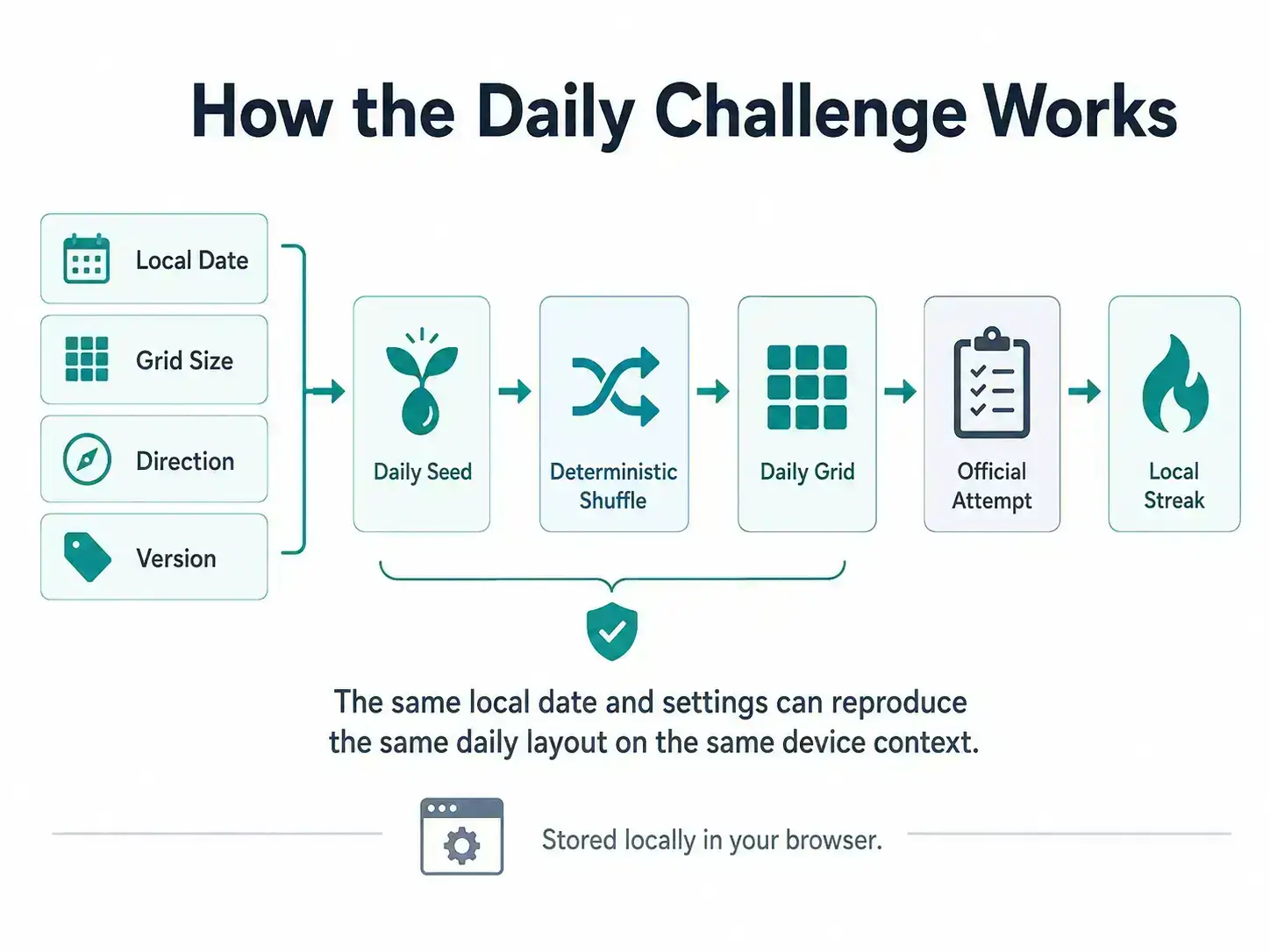
The current implementation combines four inputs: the local calendar date in YYYY-MM-DD form, grid size, ascending or descending direction, and challenge version v1. The text is hashed to a numeric seed. A deterministic pseudo-random generator supplies the choices used by a Fisher–Yates shuffle of the values 1 through the number of cells.
Deterministic means that matching inputs lead to the same stream of choices and therefore the same layout. A 5×5 ascending challenge and a 5×5 descending challenge have different seed inputs, even though both display numbers 1–25. Changing the size, date, direction, or version also creates a different input.
This is a reproducibility mechanism, not a security system. The generator is not intended for secrets, proof of identity, tamper resistance, or independent verification of a result. The local Challenge ID is a label derived from the configuration; it is useful for identifying the local task, not for proving who completed it.
challengeSeed = f(localDate, gridSize, direction, challengeVersion)

same inputs → same pseudo-random choices → same shuffled layout
2. Official and Practice are local attempt states
For one date, size, and direction, the first completed attempt that was eligible when it started is saved as the Official result. After that completion, the same configuration starts as Practice. A practice replay still records its duration and mistakes in the shared Progress Tracker, but it does not replace the daily Official record or create another Official date for the streak.
The lock is deliberately local. The page checks the daily records and incomplete markers in this browser. It does not contact an account service. Completing the configuration on a laptop cannot lock it on a phone, and clearing the relevant site storage removes the evidence the browser used to recognize the earlier attempt.
Official
The first locally eligible completed attempt for one date + grid size + direction. It is saved in the daily record set and can contribute that date to the local streak.
Practice
A later replay, or an attempt after the local Official slot was made ineligible. It can be saved to the shared Tracker but does not replace the daily record.
3. What refresh and an incomplete attempt do
When an eligible Official attempt starts, the page writes an active marker. A normal completion removes that marker and writes the completed daily record. If the page later loads and finds an active Official marker left behind, it treats that configuration as unfinished, adds its key to the local incomplete list, and makes later starts Practice replays.
This rule prevents a simple refresh from offering repeated first attempts in the same stored browser state. It cannot prove why the page stopped: refresh, tab closure, a crash, or power loss look similar to local storage. An incomplete round is not written as a completed daily result, and it does not add a completed date to the streak.
Deleting the daily data removes completed daily records, active markers, and incomplete keys after a confirmation. The site cannot recover those local daily records. Shared Tracker entries are managed separately, so clearing the Daily Challenge data is not the same control as deleting Tracker history.
4. The day follows the device calendar
The page builds YYYY-MM-DD with the device’s local year, month, and date. It changes when that device crosses local midnight. It does not use one worldwide UTC boundary. Two users in Shanghai and London can therefore be on different local challenge dates at the same instant.
The device clock and time-zone setting are part of this mechanism. If either changes, the date presented to the page can change too. The tool does not run a trusted time service or adjudicate clock changes. This is another reason to describe the challenge as a local daily workflow rather than a globally certified event.
| Device | Local calendar | Challenge input | Possible relationship |
|---|---|---|---|
| Device A | 2026-08-20, 00:15 | 2026-08-20 | New local day |
| Device B | 2026-08-19, 17:15 | 2026-08-19 | Still previous local day |
5. How current streak, longest streak, and the calendar work
The streak calculation takes the distinct dates in completed Official daily records. Consecutive calendar dates form a run. Longest streak is the largest run in the saved set. Current streak is the run ending today or yesterday; it becomes zero if the last saved date is more than one day behind the device-local today.
The interface can show the last 7 or 30 calendar days, with a filled square where at least one Official record exists on a date. Multiple Official configurations on one date still contribute one distinct participation date to the streak. Practice Tracker records do not create additional streak dates.
These values answer only whether this browser retains qualifying daily completions on consecutive dates. A streak is a local participation record, not a measure of ability, attention, intelligence, or likely transfer to reading or study.
6. Why the page has no global leaderboard
A credible shared ranking would need rules and evidence the current tool does not collect. There is no verified identity, cross-device Official lock, normalized screen or input condition, trusted clock, or server-held completion history. Site data can also be cleared, and a phone and laptop can maintain separate local records.
Even raw times differ with grid size, direction, touch versus mouse, display layout, interruptions, and mistake count. Publishing a rank from these unverified conditions would imply comparability the page cannot establish. The current design instead displays the raw local time, mistakes, attempt type, and Challenge ID without turning them into a public standing.
- No account or identity verification
- No cross-browser Official-attempt lock
- No normalized device or input setup
- No trusted external clock
- No server-held daily history
- No shared population dataset
7. What the result can and cannot say
The result can document that the current browser completed a particular local-date configuration in a recorded duration with a recorded number of incorrect selections. The Progress Tracker can keep that round alongside other supported attempts and filter it as Daily challenge mode.
It cannot establish that every person worldwide saw the same date at that instant, prove an unaided first attempt, provide a population rank, or serve as a health or educational assessment. For a fresh arrangement unrelated to the daily date, use the Generator. For the difference between fresh, deterministic, and explicitly seeded workflows, continue to the next article.
Frequently asked questions
Does everyone worldwide get the same challenge date at the same moment?
No. The page uses each device’s local calendar date, so devices in different time zones can use different date inputs at the same instant.
Can I retry today’s grid?
Yes. After an Official completion—or after a locally detected unfinished Official start—the same date, size, and direction opens as Practice.
Does clearing site data reset the local Official record?
It can remove the daily records and locks the page relies on. The site has no account record with which to restore or verify that earlier completion.
Is the Challenge ID proof of a verified result?
No. It identifies the date/configuration-derived challenge locally; it does not verify identity, conditions, or completion.